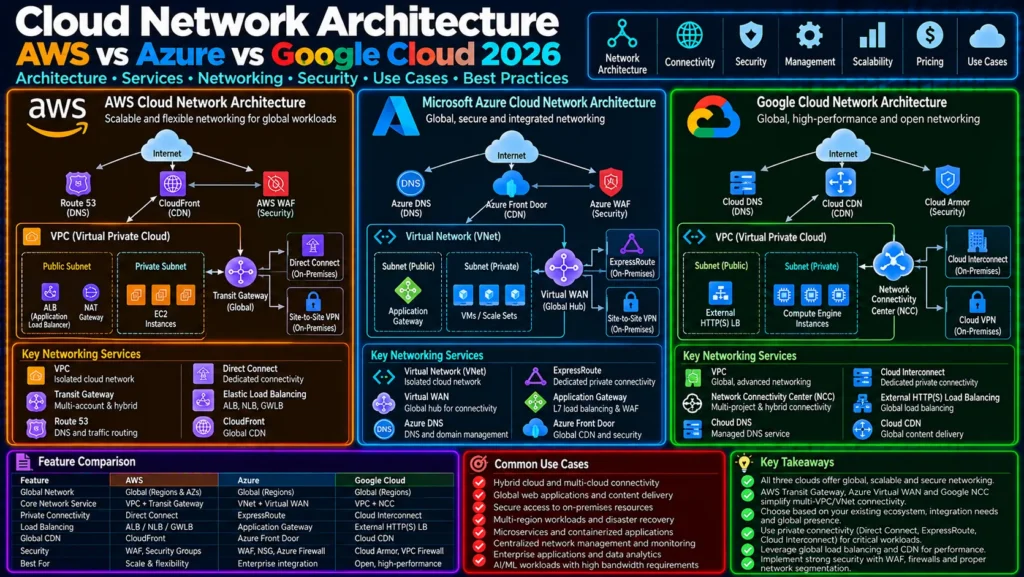
Cloud Network Architecture Explained: How AWS, Azure, and Google Cloud Build Global Networks
Introduction
Modern cloud computing depends on much more than virtual machines and data centers. Behind applications hosted on Amazon Web Services (AWS), Microsoft Azure, and Google Cloud is a complex networking architecture that connects users, workloads, regions, availability zones, private networks, and on-premises infrastructure.
Understanding cloud network architecture is essential for network engineers, cloud architects, DevOps engineers, and system administrators. The way traffic moves between networks can directly affect application latency, availability, security, scalability, and operational costs.
Although cloud providers manage much of the underlying physical infrastructure, customers remain responsible for designing IP address spaces, routing policies, network segmentation, access controls, and hybrid connectivity.
This guide explains how cloud networking works and compares the architectural approaches used by AWS, Azure, and Google Cloud. It focuses on virtual networks, global connectivity, regional design, routing, hybrid cloud, multicloud networking, and security.
If you are new to cloud computing, start with our Cloud Computing Explained guide before exploring the network architecture covered here.
1. What Is Cloud Network Architecture?
Cloud network architecture describes the physical and virtual networking systems that connect cloud workloads, users, data centers, regions, and external networks.
A simplified traffic path looks like this:
User or Client
      |
      v
Internet or Private Connection
      |
      v
Cloud Edge Network
      |
      v
Cloud Provider Network
      |
      v
Cloud Region
      |
      v
Virtual Network
      |
      v
Subnet
      |
      v
Application or Workload
Cloud networking operates across several interconnected layers.
Physical networking layer
The physical layer includes infrastructure such as:
- Routers and switches
- Fiber-optic links
- Submarine cables
- Data centers
- Edge locations
- Network interfaces
- Physical connectivity between facilities
Cloud customers generally do not configure these physical components directly. The provider operates the underlying infrastructure.
Software-defined networking layer
Cloud providers expose virtual networking resources through APIs, management portals, and automation tools.
These resources can include:
- Virtual networks
- Subnets
- Route tables
- Network firewalls
- Gateways
- Load balancers
- Private endpoints
- Network connectivity services
This abstraction allows organizations to create and manage networks without purchasing or configuring every physical networking device.
Workload connectivity layer
The workload layer determines how applications and services communicate.
For example, a production application might use:
- A public-facing load balancer
- Private application subnets
- A database subnet
- A centralized firewall
- Private connectivity to an on-premises data center
These layers work together to create a complete cloud network architecture.
For additional networking fundamentals, see our Computer Networking Explained guide.
2. Understanding Cloud Virtual Networks
Each major cloud provider offers a virtual networking service that forms the foundation of its architecture.
| Provider | Virtual Network | Main Purpose |
|---|---|---|
| AWS | Amazon Virtual Private Cloud (VPC) | Provides isolated virtual networks for AWS resources |
| Microsoft Azure | Azure Virtual Network (VNet) | Connects Azure resources through private IP networking |
| Google Cloud | Virtual Private Cloud (VPC) | Provides global virtual networking with regional subnets |
These services support common networking concepts such as:
- IP address ranges
- Subnets
- Routing
- Network security rules
- Gateways
- Private connectivity
- Workload isolation
However, their regional scope and connectivity models are different.
Understanding these differences is important when designing networks that span multiple regions.
3. AWS Network Architecture
AWS networking is primarily organized around the Amazon Virtual Private Cloud (VPC).
An AWS VPC is a logically isolated virtual network that operates within an AWS Region.
It provides an address space in which resources such as EC2 instances, load balancers, databases, and container workloads can communicate.
AWS VPC architecture
A typical application environment may use separate subnets for different workload roles:
                 Internet
                    |
                    v
              Internet Gateway
                    |
                    v
                 AWS VPC
                    |
          +---------+---------+
          |         |         |
          v         v         v
       Public   Application  Database
       Subnet     Subnet      Subnet
          |         |         |
       Load       App       Database
       Balancer  Servers     Servers
A VPC uses an IPv4 CIDR range, for example:
10.10.0.0/16This address space can be divided into smaller subnets.
10.10.1.0/24    Public subnet
10.10.10.0/24   Application subnet
10.10.20.0/24   Database subnet
AWS subnets are associated with Availability Zones. A VPC can contain subnets in multiple Availability Zones within its Region.
Route tables determine how traffic leaving a subnet is forwarded. Depending on the architecture, routes may point to an internet gateway, NAT gateway, transit gateway, virtual private gateway, or other supported targets.
AWS network connectivity
AWS provides several services for connecting VPCs, data centers, and external networks.
Important examples include:
- VPC Peering
- AWS Transit Gateway
- AWS Direct Connect
- AWS Site-to-Site VPN
- Internet Gateway
- NAT Gateway
The appropriate service depends on the number of networks, connectivity requirements, routing design, and availability objectives.
AWS Transit Gateway
When an organization operates many VPCs, establishing and managing individual connections can become difficult.
AWS Transit Gateway provides a centralized transit architecture for connecting VPCs and external networks.
Conceptually:
          VPC A
            |
VPC B --- Transit --- VPC C
          Gateway
         /       \
      VPC D     VPC E
Transit Gateway uses attachments and route tables to control traffic between connected networks. Separate route tables can help isolate environments and control which networks communicate.
For a detailed comparison of Transit Gateway and equivalent services from other cloud providers, see our dedicated guide:
AWS Transit Gateway vs Azure Virtual WAN vs Google Network Connectivity Center.
4. Microsoft Azure Network Architecture
Microsoft Azure uses Azure Virtual Network (VNet) as the foundation of private cloud networking.
A VNet provides an isolated IP address space for Azure resources.
A typical environment might include:
                 Azure VNet
                     |
       +-------------+-------------+
       |             |             |
       v             v             v
   Frontend     Application     Database
    Subnet         Subnet         Subnet
Each VNet belongs to an Azure Region and can contain multiple subnets.
Subnets allow administrators to organize workloads and apply appropriate routing and security policies.
Azure VNet Peering
VNet Peering allows two virtual networks to communicate privately.
Peering can connect networks within the same region or across supported regions.
Azure carries peered network traffic over Microsoft’s backbone rather than requiring the communication to traverse the public Internet.
However, traditional VNet Peering is non-transitive.
For example:
VNet A ---- VNet Hub ---- VNet BA connection from VNet A to the hub does not automatically provide connectivity from VNet A to VNet B. Additional routing or a suitable centralized connectivity architecture is required.
Azure Hub-and-Spoke Networking
Hub-and-spoke architecture is a common approach for organizing large Azure environments.
The hub provides shared networking services, while spoke VNets contain separate application environments.
                 Spoke VNet
                      |
                      |
Spoke VNet -------- HUB -------- Spoke VNet
                      |
                      |
                 Spoke VNet
A hub can contain services such as:
- Azure Firewall
- VPN Gateway
- ExpressRoute Gateway
- DNS services
- Network Virtual Appliances
- Centralized monitoring
This architecture provides a central location for connectivity, security inspection, and network management.
Azure Virtual WAN
For larger environments, Microsoft provides Azure Virtual WAN.
Virtual WAN uses Microsoft-managed virtual hubs to connect VNets, branch offices, VPN connections, and ExpressRoute circuits.
When multiple virtual hubs are deployed, they can interconnect over Microsoft’s backbone, providing managed global transit between connected networks.
This can reduce the need to manually build and maintain complex inter-region routing arrangements.
It is important to distinguish traditional customer-managed hub-and-spoke networks from Virtual WAN. They provide related architectural capabilities but use different management and routing models.
For further information, see Microsoft’s official Azure Virtual WAN network topology documentation.
5. Google Cloud Network Architecture
Google Cloud uses Virtual Private Cloud (VPC) networks as the foundation of its networking architecture.
One important difference is that a Google Cloud VPC network is a global resource, while its subnets are regional.
Conceptually:
                 Global VPC
                     |
          +----------+----------+
          |          |          |
          v          v          v
       US Subnet  Europe      Asia
                  Subnet      Subnet
This allows resources in different regions to use the same VPC network, subject to routing, firewall policies, IP addressing, and regional service requirements.
A Google Cloud VPC can include:
- Subnets
- Routes
- Firewall rules
- Network interfaces
- Cloud VPN connectivity
- Cloud Interconnect
- Cloud Router
- Load balancing services
The global VPC model can simplify some multi-region designs because organizations do not necessarily need a separate VPC for every region.
However, network segmentation and IP address planning remain important.
For technical details, see the official Google Cloud VPC documentation.
Google Cloud Network Connectivity Center
Google Cloud provides Network Connectivity Center (NCC) for managing connectivity between multiple networks and hybrid environments.
NCC uses a hub-and-spoke model.
                 VPC A
                   |
                   |
On-Premises ---- NCC Hub ---- VPC B
                   |
                   |
              Hybrid Spoke
Depending on the architecture, NCC can connect:
- Google Cloud VPC networks
- On-premises networks
- Other cloud environments
- Cloud VPN resources
- Cloud Interconnect resources
- Supported network appliances
A centralized hub allows organizations to manage network connectivity and route exchange across multiple spokes.
Google Cloud NCC is particularly useful when network environments extend beyond a single VPC or region.
See Google’s official Network Connectivity Center overview.
6. Comparing AWS, Azure, and Google Cloud Network Architecture
The three providers solve many of the same networking problems, but their resource models and connectivity services differ.
| Architecture Area | AWS | Microsoft Azure | Google Cloud |
|---|---|---|---|
| Virtual network | VPC | VNet | VPC |
| Virtual network scope | Regional | Regional | Global |
| Subnet scope | Availability Zone | Regional VNet subnet | Regional |
| Centralized connectivity | Transit Gateway | Virtual WAN or managed hub-and-spoke | Network Connectivity Center |
| Dedicated hybrid connectivity | Direct Connect | ExpressRoute | Cloud Interconnect |
| VPN connectivity | Site-to-Site VPN | VPN Gateway | Cloud VPN |
| Dynamic routing | BGP-supported connectivity services | BGP-supported connectivity services | Cloud Router and BGP |
| Global network | AWS global infrastructure | Microsoft global network | Google global infrastructure |
The most important distinction is not the name of each service. It is how the provider organizes networks, regions, routing, and connectivity.
For a broader comparison of cloud platforms and their services, see our AWS vs Azure vs Google Cloud comparison.
7. Cloud Backbone Networks
A major component of cloud networking is the provider’s global backbone.
A backbone is a high-capacity network that connects geographically distributed infrastructure.
Major cloud providers operate private networking infrastructure that connects their data centers, regions, and edge locations.
A simplified model is:
          Cloud Region A
                 |
                 |
          Provider Backbone
                 |
                 |
          Cloud Region B
This infrastructure can carry traffic between provider locations without relying entirely on unrelated public Internet transit networks.
However, not every packet exchanged by a cloud application automatically follows the same path.
The actual route depends on:
- The cloud service being used
- Source and destination locations
- Routing configuration
- Public or private connectivity
- Network peering arrangements
- Provider service architecture
Microsoft documents its global network as infrastructure connecting Azure regions and other Microsoft services.
Google provides global networking capabilities through its VPC, Cloud Interconnect, Cloud VPN, and Network Connectivity Center services.
AWS operates global network infrastructure supporting its regional and edge services.
The practical lesson is that cloud backbone networks provide important connectivity capabilities, but engineers must still understand the routing behavior of the specific services they deploy.
8. Regional and Multi-Region Network Architecture
One of the first decisions in cloud network design is whether an application should operate in a single region or across multiple regions.
Regional architecture
A regional architecture keeps the main application components within one cloud region.
              Users
                |
                v
          Load Balancer
                |
                v
             Region A
                |
          +-----+-----+
          |           |
       Application  Database
This design is often easier to operate because it uses fewer network paths and has fewer cross-region dependencies.
However, the application can remain vulnerable to regional outages and other regional failure scenarios.
Multi-region architecture
A multi-region design distributes workloads across two or more regions.
                 Users
                   |
             Global Routing
              /          \
             v            v
         Region A      Region B
            |              |
         App A            App B
            |              |
            +------Data----+
This can improve geographic availability and support users in different locations.
However, it introduces additional requirements:
- Cross-region routing
- Data replication
- Application consistency
- DNS or global traffic management
- Failure detection
- Recovery procedures
- Inter-region traffic costs
- Capacity planning
A multi-region architecture is not automatically highly available. Applications, databases, network paths, and dependencies must all be designed to support the intended failure scenarios.
For a broader explanation of availability, redundancy, and failover, see High Availability Explained.
9. Hybrid Cloud Networking
Many organizations operate both cloud and on-premises infrastructure.
A hybrid cloud architecture connects these environments so that applications and systems can communicate across them.
A simplified design is:
       Corporate Data Center
                 |
                 |
        Private Connectivity
                 |
                 |
          Cloud Network
                 |
          +------+------+
          |             |
       Application   Database
Major cloud providers offer dedicated connectivity services.
| Provider | Dedicated Connectivity |
|---|---|
| AWS | AWS Direct Connect |
| Microsoft Azure | Azure ExpressRoute |
| Google Cloud | Cloud Interconnect |
Organizations can also use encrypted VPN connections over the Internet.
Dynamic routing in hybrid environments
BGP is commonly used to exchange network routes between cloud connectivity services and external routers.
For example:
On-Premises Router
        |
      BGP
        |
Cloud Connectivity
        |
Cloud Network
Dynamic routing helps networks exchange reachability information without requiring every route to be configured manually.
However, engineers must still plan:
- Advertised prefixes
- Route filtering
- Routing priorities
- Redundant paths
- Failover behavior
- Overlapping IP address ranges
For a deeper technical explanation of route exchange across cloud providers, see our BGP in Cloud Networking guide.
10. Multicloud Network Architecture
A multicloud environment uses services from more than one cloud provider.
For example, an organization might run application services in AWS, identity services in Azure, and data analytics workloads in Google Cloud.
A simplified architecture might look like:
              Enterprise Network
                     |
                     |
                Global WAN
              /      |      \
             v       v       v
           AWS     Azure    Google
Connectivity can be established using different approaches:
- Site-to-site VPN
- Dedicated interconnects
- SD-WAN platforms
- Network virtual appliances
- Cloud provider connectivity services
- Specialized multicloud networking platforms
Google Cloud also offers Cross-Cloud Interconnect capabilities for supported connectivity scenarios.
Main multicloud networking challenges
A multicloud design introduces more operational complexity.
The main challenges include:
IP address management
Different cloud environments must use compatible and non-overlapping address spaces wherever possible.
Routing consistency
Networks must exchange and select routes predictably across providers.
Security policies
Security controls should be consistent enough to enforce organizational requirements across multiple environments.
DNS management
Applications must resolve the correct internal and external services.
Monitoring and visibility
Administrators need to understand network health across different providers.
Cost management
Data transfer between cloud providers and regions can introduce additional costs.
A successful multicloud architecture should be designed around the application’s actual requirements rather than simply connecting every available network.
11. Why Routing Matters in Cloud Networks
Routing determines how packets travel between networks.
Even when the provider manages the physical network, customers must configure and understand the logical routing environment.
Consider an organization with the following address space:
10.20.0.0/16
   |
   +--- Cloud Network
   |
   +--- On-Premises Network
Overlapping address ranges can create routing ambiguity and prevent networks from communicating correctly.
Other problems can arise from:
- Incorrect route propagation
- Missing return routes
- Asymmetric routing
- Incorrect route priorities
- Unexpected NAT behavior
- Firewall state conflicts
- BGP route advertisements
These problems are not unique to cloud platforms. They are extensions of traditional networking challenges.
For practical examples of routing problems, see our guides:
- Linux Traffic Uses the Wrong Interface
- Linux rp_filter and Asymmetric Routing
- Netplan Multiple Default Routes and Policy Routing
Understanding IP addressing, route selection, and return paths remains essential when designing hybrid and multicloud environments.
12. Cloud Network Security
Connectivity alone is not sufficient. Every cloud network architecture needs appropriate security controls.
A simplified security design looks like:
Internet
   |
Edge Protection
   |
Network Firewall
   |
Application Network
   |
Workload Security
   |
Protected Services
Cloud environments may combine several types of security controls.
Network-level security
Controls such as security groups, network security groups, and VPC firewall rules help restrict traffic between workloads and network boundaries.
Centralized firewall inspection
Centralized firewalls can inspect traffic flowing between networks, application tiers, and external destinations.
Network segmentation
Separating production, development, management, and database environments reduces unnecessary communication.
Private connectivity
Private endpoints and private network connections can reduce exposure of sensitive services to public networks.
Identity and access control
Network access should be combined with appropriate identity policies and least-privilege permissions.
Monitoring and threat detection
Collecting network and security events helps identify unexpected traffic, suspicious connections, and policy violations.
For more information about threat detection, see our Intrusion Detection and Prevention Systems guide.
Security events can also be centralized for analysis. Our SIEM Explained guide covers log collection, event correlation, and security monitoring.
13. Cloud Networking and Infrastructure as Code
Modern cloud networks are increasingly managed through code instead of manual configuration through web dashboards.
A network deployment may include:
Virtual Network
      |
Subnets
      |
Route Tables
      |
Firewall Policies
      |
Gateways
      |
Load Balancers
      |
Monitoring
Infrastructure as Code (IaC) allows these resources to be described using machine-readable configuration files.
This approach can improve:
- Configuration consistency
- Repeatability
- Change review
- Version control
- Deployment automation
- Infrastructure documentation
Tools such as Terraform and OpenTofu can manage supported resources across multiple cloud providers.
Automation does not eliminate the need for network design, testing, access control, and change management.
For a dedicated explanation, read our Infrastructure as Code Explained guide.
14. Designing a Production Cloud Network
A production cloud network should begin with an architecture plan rather than a collection of individual cloud services.
The following steps provide a practical starting point.
Step 1: Define network environments
Identify which environments require isolation.
For example:
Production
Development
Testing
Management
Security
Shared Services
Depending on the security requirements, these environments may use separate virtual networks, subnets, routing domains, or cloud accounts.
Step 2: Plan IP addressing
Create an address plan that avoids overlapping networks across cloud regions and connected on-premises environments.
For example:
10.10.0.0/16   Production
10.20.0.0/16   Development
10.30.0.0/16   Shared Services
10.40.0.0/16   Management
The exact ranges should be selected according to the organization’s existing network allocations.
Step 3: Select a connectivity model
Decide whether the environment needs:
- Direct connectivity between virtual networks
- Centralized transit routing
- Hybrid connectivity
- Multi-region connectivity
- Multicloud connectivity
The architecture should match the number of networks and the expected traffic patterns.
Step 4: Design security boundaries
Define where firewalls, network inspection, segmentation, and access policies will be applied.
Avoid allowing unnecessary communication between application tiers.
Step 5: Plan high availability
Consider how the network should behave when:
- A VPN tunnel fails
- A BGP session drops
- A gateway becomes unavailable
- A region experiences an outage
- A route is withdrawn
- A firewall fails
For important workloads, design and test appropriate redundant paths.
Step 6: Establish monitoring
Monitor network availability, latency, errors, route changes, VPN status, and traffic flows.
Monitoring should cover both individual network components and the end-to-end application experience.
Step 7: Document and automate
Maintain network diagrams, IP allocation records, routing policies, firewall rules, and connectivity dependencies.
Where practical, manage repeatable network configurations using Infrastructure as Code.
15. Common Cloud Networking Mistakes
Even well-designed cloud environments can experience networking problems when important architectural principles are ignored.
Overlapping IP address ranges
Using overlapping CIDR ranges across cloud networks and on-premises environments can make routing difficult and require redesign or NAT.
Poor network segmentation
Placing unrelated workloads in the same network without appropriate security boundaries can increase the impact of a compromised system.
Uncontrolled route propagation
Advertising unnecessary routes can create unexpected paths and expose networks that should remain isolated.
Assuming peering is automatically transitive
Virtual network peering and centralized transit services do not always behave in the same way. Administrators must understand the routing model of the service they use.
Ignoring return paths
A packet may reach its destination while the response follows an invalid or blocked path.
Treating VPN and dedicated connectivity as identical
VPN and dedicated interconnect services have different characteristics, performance considerations, security models, and cost structures.
Ignoring data transfer costs
Cross-region and cross-cloud communication can introduce additional network charges.
Designing without failure testing
A network should be tested under realistic failure conditions rather than assuming that redundant links and gateways will work automatically.
16. Frequently Asked Questions
What is cloud network architecture?
Cloud network architecture describes how virtual networks, routing, connectivity services, security controls, and provider infrastructure work together to connect cloud resources, users, and external networks.
What is the difference between AWS VPC, Azure VNet, and Google Cloud VPC?
All three provide virtual networking capabilities, including IP address spaces, subnets, routing, and security controls. However, their regional scope, routing models, and connectivity services differ.
Is Google Cloud VPC global?
Yes. A Google Cloud VPC network is a global resource, while its subnets are regional resources.
What is an AWS Transit Gateway?
AWS Transit Gateway is a centralized networking service that connects VPCs and external networks using attachments and routing policies.
What is Azure Virtual WAN?
Azure Virtual WAN is a managed networking service that connects virtual networks, regional hubs, branch locations, and hybrid connectivity services.
What is Google Cloud Network Connectivity Center?
Network Connectivity Center is a hub-and-spoke connectivity management framework for connecting Google Cloud networks and supported hybrid network resources.
What is a cloud backbone network?
A cloud backbone is a high-capacity network operated by a provider to connect distributed data centers, regions, and edge infrastructure.
What is hybrid cloud networking?
Hybrid cloud networking connects on-premises infrastructure with cloud networks using technologies such as VPN, Direct Connect, ExpressRoute, Cloud Interconnect, and dynamic routing.
What is multicloud networking?
Multicloud networking connects workloads and networks across multiple cloud providers while coordinating IP addressing, routing, security, monitoring, and connectivity.
Why is BGP important in cloud networking?
BGP enables dynamic exchange of routing information across supported connectivity services. It is particularly useful in hybrid and multicloud environments where networks need to exchange routes automatically.
Conclusion
Cloud network architecture combines traditional networking principles with software-defined infrastructure and globally distributed provider networks.
AWS, Azure, and Google Cloud provide different approaches to virtual networks, routing, regional connectivity, hybrid networking, and multicloud communication.
Although their terminology and services differ, the underlying engineering requirements remain familiar:
- IP address planning
- Routing and route propagation
- Network segmentation
- Firewall policies
- Hybrid connectivity
- Availability and redundancy
- Monitoring and troubleshooting
- Automation and documentation
The most important architectural decision is not simply choosing a cloud provider. It is selecting a network design that matches the application’s latency, availability, security, connectivity, operational, and cost requirements.
Understanding these principles helps network engineers and cloud architects build reliable environments that can operate across regions, enterprise data centers, and multiple cloud platforms.
Authoritative References
The following official documentation provides additional technical information: