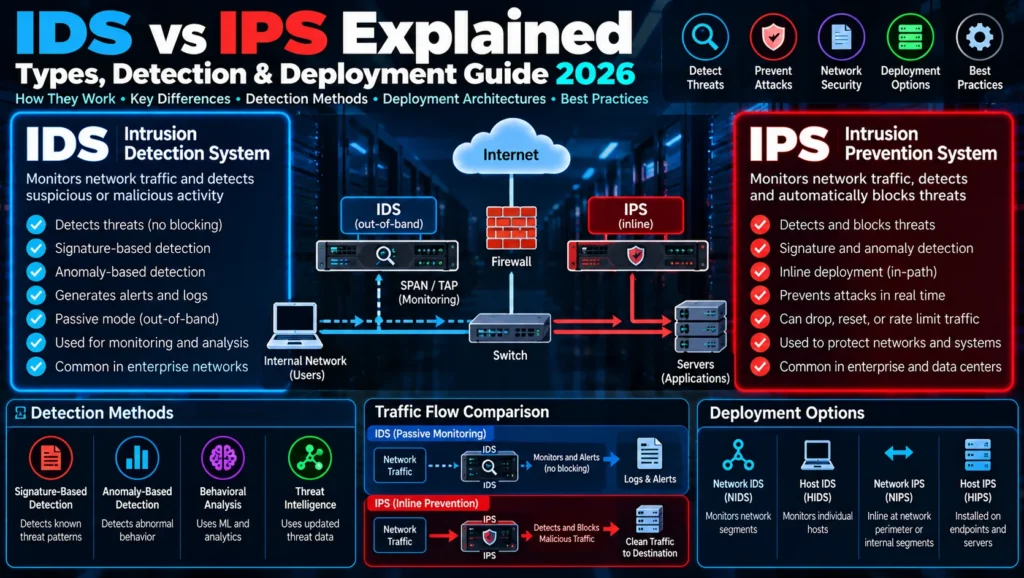
IDS vs IPS Explained: How Intrusion Detection and Prevention Systems Work
Introduction
Modern networks face continuous security threats, including malware, unauthorized access, vulnerability exploitation, reconnaissance, lateral movement, and data exfiltration.
Firewalls enforce network access policies, but allowing a connection does not necessarily mean that its traffic is harmless. An attacker may exploit an application, use stolen credentials, or communicate through an otherwise legitimate network service.
Organizations therefore need additional security technologies that can inspect activity, identify suspicious behavior, and respond to potential attacks.
Two important technologies provide these capabilities:
- Intrusion Detection System (IDS): Monitors network or host activity and generates alerts when it identifies potentially malicious behavior.
- Intrusion Prevention System (IPS): Detects suspicious activity and can actively block or disrupt it, depending on its deployment and configuration.
Together, these capabilities are commonly described as Intrusion Detection and Prevention Systems (IDPS).
An IDS provides visibility into possible security incidents. An IPS adds an enforcement capability that can prevent selected malicious activity from reaching protected systems.
Both technologies are important components of defense in depth, alongside firewalls, endpoint protection, network segmentation, identity security, and centralized monitoring.
This guide explains the difference between IDS and IPS, their major types, detection methods, deployment architectures, security integrations, and practical considerations for operating them in enterprise networks.
1. What Is an Intrusion Detection System (IDS)?
An Intrusion Detection System (IDS) monitors events occurring on a network or host and analyzes them for indications of attacks, policy violations, or suspicious activity.
Its primary purpose is detection and visibility.
An IDS can:
- Inspect network traffic.
- Monitor operating-system activity.
- Identify known attack patterns.
- Detect unusual communication.
- Monitor authentication events.
- Generate security alerts.
- Record suspicious activity.
- Provide information for incident investigation.
A typical passive network IDS receives a copy of traffic without becoming part of the normal forwarding path.
                 Internet
                    |
                 Firewall
                    |
                 Switch
                /      \
               /        \
          Servers      Users
               \        /
                \      /
              Mirrored Traffic
                    |
                    v
                 IDS Sensor
                    |
                    v
                  Alerts
The IDS analyzes observed activity and reports events that match its detection logic.
A traditional passive IDS does not directly block the original packets. Its main role is to identify suspicious activity and provide information to security teams.
An IDS may also be installed directly on a host, where it monitors files, processes, authentication activity, system logs, and other local events.
2. What Is an Intrusion Prevention System (IPS)?
An Intrusion Prevention System (IPS) performs detection while also providing the ability to enforce security actions.
Depending on the product and configuration, an IPS may:
- Drop suspicious packets.
- Reject unwanted connections.
- Block traffic that matches a prevention rule.
- Reset selected sessions.
- Apply temporary blocking policies.
- Prevent known exploit traffic from reaching protected systems.
A network-based IPS is typically deployed inline, meaning that relevant traffic passes through the inspection system.
                 Internet
                    |
                 Firewall
                    |
                    v
                Inline IPS
                    |
                    v
               Core Switch
                    |
           +--------+--------+
           |        |        |
         Servers   Users    DMZ
Because the IPS is part of the forwarding path, it can inspect traffic and apply prevention actions before the traffic reaches its destination.
This creates additional engineering requirements.
The system must have enough processing capacity, acceptable latency, suitable failure handling, and a configuration that does not unnecessarily interrupt legitimate communication.
Host-based IPS products use a different architecture. They enforce policies locally on the protected endpoint rather than necessarily sitting inline between network devices.
3. IDS vs IPS: What Is the Difference?
The main difference is the role each technology performs.
An IDS primarily detects and reports suspicious activity. An IPS can additionally enforce prevention actions.
| Feature | IDS | IPS |
|---|---|---|
| Detect suspicious activity | Yes | Yes |
| Generate alerts | Yes | Yes |
| Record security events | Yes | Yes |
| Passive network monitoring | Common | Not the normal NIPS role |
| Network traffic blocking | Not its primary function | Yes |
| Inline network deployment | Usually unnecessary | Common for NIPS |
| Host-level monitoring | HIDS | HIPS |
| False-positive impact | Mainly alert noise | May interrupt legitimate activity |
| Main objective | Visibility | Detection and prevention |
The distinction is important when designing a security architecture.
A passive IDS can provide useful visibility without becoming a direct dependency in the traffic path.
An inline IPS can stop selected malicious traffic, but incorrect rules or device failures may affect network availability.
Remember: IDS identifies suspicious activity; IPS can attempt to prevent it.
The two capabilities are often integrated into the same security product, so organizations do not always need separate physical appliances.
4. How IDS and IPS Work
Although implementations differ, most IDS/IPS platforms follow a similar processing sequence.
             Network or Host Events
                       |
                       v
                Data Collection
                       |
                       v
               Traffic Normalization
                       |
                       v
                Detection Engine
                       |
                       v
              Rule and Behavior Analysis
                       |
                       v
               Detection Decision
                       |
                 +-----+-----+
                 |           |
                 v           v
               Alert       Prevention
                 |           |
                 +-----+-----+
                       |
                       v
                 Event Logging
                       |
                       v
                      SIEM
The main stages include:
1. Data collection
The system receives network packets, host events, application information, or other telemetry.
2. Normalization and analysis
It organizes the collected data so that protocols, sessions, events, and relevant fields can be analyzed consistently.
3. Detection
The detection engine evaluates the information against signatures, protocol rules, behavioral patterns, and configured policies.
4. Response
An IDS normally generates an alert. An IPS may additionally apply an action such as dropping or rejecting matching traffic.
5. Logging and investigation
Events are recorded and may be forwarded to a SIEM or another monitoring platform.
The quality of detection depends on traffic visibility, sensor placement, detection rules, system resources, and configuration.
5. Types of IDS and IPS
IDS/IPS technologies are commonly classified according to where they operate and which events they monitor.
Network-Based IDS (NIDS)
A Network-Based Intrusion Detection System monitors network traffic to identify suspicious communication.
It may be deployed at Internet gateways, DMZ boundaries, data-center segments, or internal network boundaries.
A NIDS commonly receives traffic through a network TAP or switch mirroring configuration.
Network-Based IPS (NIPS)
A Network-Based Intrusion Prevention System inspects traffic while operating inline.
It can apply prevention rules before selected traffic reaches protected systems.
Host-Based IDS (HIDS)
A Host-Based Intrusion Detection System monitors activity on an individual machine.
Depending on the platform, it may observe:
- System logs.
- Authentication events.
- File changes.
- Processes.
- System configuration.
- User activity.
- Security-related operating-system events.
HIDS is particularly useful for critical servers where network monitoring alone does not provide sufficient visibility.
Host-Based IPS (HIPS)
A Host-Based Intrusion Prevention System enforces security policies directly on an endpoint.
It may prevent selected unauthorized process activity, suspicious file modifications, or other behaviors supported by the product.
Wireless IDS/IPS
Wireless intrusion detection and prevention systems monitor Wi-Fi environments.
They can help identify rogue access points, unauthorized wireless devices, policy violations, and suspicious wireless activity.
A wireless prevention system may also take action against selected unauthorized wireless infrastructure, subject to the platform and applicable legal requirements.
Network Behavior Analysis
Network behavior analysis focuses on communication patterns rather than depending exclusively on known attack signatures.
It can help identify unusual traffic volumes, suspicious connections, internal scanning, or unexpected communication.
These approaches can complement traditional IDS/IPS engines.
6. IDS/IPS Detection Methods
Detection systems use different techniques to identify suspicious activity.
The most common approaches include signature-based detection, anomaly-based detection, stateful protocol analysis, and behavioral detection.
A mature security architecture may combine several methods.
6.1 Signature-Based Detection
Signature-based detection compares observed activity with known patterns associated with malicious behavior.
A signature may identify:
- Known exploit patterns.
- Malware communication.
- Suspicious application requests.
- Recognized attack sequences.
- Known malicious indicators.
A simplified example:
Incoming Traffic
       |
       v
Matches Known Signature?
       |
   +---+---+
   |       |
  Yes      No
   |       |
 Alert   Continue
Signature detection is particularly useful for known threats.
Its main limitation is that a new or modified attack may not match an existing signature.
For this reason, organizations should combine signature detection with other forms of monitoring.
6.2 Anomaly-Based Detection
Anomaly-based detection identifies behavior that differs from an established baseline or expected operating pattern.
For example:
Normal Activity:
Server generates 60 DNS queries per hour

Unusual Activity:
Server generates 15,000 DNS queries per hour
This behavior may indicate malware, DNS tunneling, a misconfigured application, or another unusual condition.
However, an unusual event is not automatically malicious.
Legitimate backups, software updates, monitoring systems, vulnerability scanners, and application changes can also produce unusual traffic.
Anomaly detection therefore needs suitable baselines and contextual investigation.
6.3 Stateful Protocol Analysis
Stateful protocol analysis examines communication according to the expected behavior of a protocol.
For example, a detection engine may evaluate whether messages follow an expected protocol sequence or whether an application session contains malformed or suspicious behavior.
This can help identify activity that does not match normal protocol operation.
Protocol-aware analysis is valuable because an attacker may use a legitimate protocol in an unusual or abusive way.
6.4 Behavioral Detection
Behavioral detection examines activity patterns rather than relying only on individual packets or known signatures.
For example:
Workstation
    |
    v
Unexpected Login Activity
    |
    v
Access to Multiple Servers
    |
    v
Repeated Administrative Attempts
    |
    v
Unusual Internal Connections
A sequence of individually ordinary events may indicate reconnaissance, lateral movement, or compromised credentials when examined together.
Behavioral detection becomes more useful when combined with identity events, endpoint telemetry, DNS information, and firewall logs.
7. How IDS/IPS Rules Work
Detection rules define the conditions that must be met before a system generates an alert or applies a prevention action.
A rule may examine:
- Protocol.
- Source IP address.
- Destination IP address.
- Source and destination ports.
- Traffic direction.
- Session state.
- Application protocol.
- Payload characteristics.
- Detection thresholds.
- Required response action.
A simplified conceptual rule looks like this:
IF:
    Protocol = TCP
AND:
    Destination = Protected Server
AND:
    Traffic matches suspicious pattern

THEN:
    Generate Alert
An IPS rule may define a blocking action instead:
THEN:
    Drop Matching Traffic
Real rules are more sophisticated and may examine multiple protocol and application conditions.
For example, the official Snort 3 Rule Writing Guide explains how rule headers specify actions, protocols, addresses, ports, and traffic direction, while rule options define the matching conditions.
Rule quality directly affects detection accuracy.
Overly broad rules can generate excessive false positives, while poorly designed or incomplete rules may miss malicious activity.
8. False Positives and False Negatives
Detection accuracy is one of the most important operational considerations.
False Positives
A false positive occurs when legitimate activity is incorrectly classified as suspicious or malicious.
For example:
Legitimate Backup
       |
       v
Large Data Transfer
       |
       v
Detection Rule Triggers
       |
       v
False Positive
Too many false positives can create alert fatigue.
Security analysts may spend excessive time investigating harmless events, making it harder to identify real attacks.
False Negatives
A false negative occurs when malicious activity is not detected.
Actual Attack
      |
      v
Detection Engine
      |
      X
No Alert
False negatives can allow an attack to continue without defenders receiving the expected warning.
Organizations should balance detection sensitivity with operational noise.
The goal is not to generate the largest possible number of alerts. The goal is to produce useful, actionable detection.
9. IDS vs IPS vs Firewall
IDS, IPS, and firewalls are related technologies, but they have different primary responsibilities.
| Technology | Primary Function |
|---|---|
| Firewall | Enforces network access policies |
| IDS | Detects suspicious activity |
| IPS | Detects and attempts to block suspicious activity |
| EDR | Monitors and responds to endpoint threats |
| SIEM | Collects and correlates security events |
| NAC | Controls which devices can access a network |
A useful way to distinguish their roles is:
Firewall:
Should this connection be allowed?

IDS:
Does this activity look suspicious?

IPS:
Should this detected activity be blocked?

EDR:
What is happening on the endpoint?

SIEM:
What do these events mean when correlated?
A modern next-generation firewall may include integrated IPS capabilities.
However, combining products into one appliance does not eliminate the conceptual difference between access control and intrusion detection.
For a detailed explanation of firewall operation and security policies, see Firewalls Explained.
10. IDS/IPS Deployment Architectures
Deployment architecture determines what the security system can observe and whether it can block the traffic.
10.1 Passive IDS Deployment
A passive IDS receives a copy of traffic using a network TAP or a switch mirroring feature.
                Network Traffic
                      |
                 Physical Switch
                      |
             +--------+--------+
             |                 |
          Destination      Mirrored Copy
                               |
                               v
                              IDS
                               |
                               v
                             Alerts
The original traffic continues through the network.
Advantages include:
- No direct dependency on the IDS for packet forwarding.
- Lower deployment risk.
- Useful visibility across selected network segments.
- Ability to monitor traffic without actively blocking it.
A limitation is that a passive IDS cannot directly stop the original traffic it observes.
Visibility also depends on the monitoring configuration. An incorrectly configured mirror port or an overloaded monitoring interface may result in missing packets.
10.2 Inline IPS Deployment
An inline IPS is placed directly in the communication path.
              Internet
                  |
               Firewall
                  |
               Inline IPS
                  |
               Core Switch
                  |
             Protected Systems
The IPS can inspect traffic and apply configured prevention actions.
Advantages include:
- Active traffic enforcement.
- Ability to block matching malicious traffic.
- Protection before selected traffic reaches protected systems.
However, incorrect blocking rules, insufficient capacity, excessive latency, or hardware failure may affect legitimate communication.
10.3 Host-Based Deployment
Host-based detection and prevention operate directly on individual endpoints.
           Protected Server
                  |
          +-------+-------+
          |       |       |
        Files  Processes  Logs
          |       |       |
          +-------+-------+
                  |
              HIDS / HIPS
                  |
              Security Events
This architecture provides visibility into local activity that may not be available from a network sensor.
Host-based systems are particularly useful for critical infrastructure, identity servers, databases, and systems where file or process monitoring is important.
11. Where Should IDS and IPS Be Deployed?
There is no single correct location for every IDS/IPS sensor.
Deployment should follow network topology, critical assets, expected attack paths, traffic volume, and security requirements.
Common monitoring locations include:
- Internet gateways.
- DMZ boundaries.
- Data-center networks.
- Server VLANs.
- Critical application segments.
- Management networks.
- Cloud network boundaries.
- Internal traffic paths between important systems.
Two traffic directions deserve particular attention.
North-South Traffic
North-south traffic generally crosses between internal systems and external networks.
For example:
Internal Network
       |
       v
    Firewall
       |
       v
    Internet
Monitoring this traffic can help identify suspicious external connections, exploitation attempts, or unusual outbound communication.
East-West Traffic
East-west traffic describes communication between systems inside an environment.
For example:
Web Server
    |
    v
Application Server
    |
    v
Database Server
Monitoring internal traffic can help identify lateral movement, unauthorized access, suspicious service connections, and abnormal data transfers.
A sensor that monitors only Internet traffic may not observe important internal communication.
For a deeper technical explanation of NIDS sensor placement, TAP and SPAN monitoring, network traffic visibility, and traffic analysis, see Network Intrusion Detection: NIDS, Sensors and Traffic Analysis.
12. IDS/IPS and Encrypted Traffic
Encryption creates a visibility challenge for network-based detection systems.
Consider an HTTPS connection:
Client
   |
Encrypted TLS Traffic
   |
   v
Network Sensor
   |
   v
Web Server
A passive network sensor may observe information such as:
- Source and destination IP addresses.
- Ports and transport protocols.
- Connection timing.
- Traffic volume.
- Session duration.
- Some TLS metadata.
However, it cannot automatically read the plaintext application payload inside an encrypted session.
Deeper inspection requires an appropriate architecture, such as an authorized TLS inspection gateway or telemetry collected at an endpoint or another point where the content is available.
TLS inspection introduces additional requirements, including:
- Certificate management.
- Privacy and regulatory considerations.
- Application compatibility.
- Processing capacity.
- Logging and access controls.
Organizations should not assume that encrypted traffic is harmless, but they should also not assume that every network sensor can inspect its contents.
13. IDS/IPS Integration with SIEM and EDR
IDS/IPS becomes more useful when its events are combined with information from other security systems.
SIEM Integration
A Security Information and Event Management platform collects and correlates events from multiple sources.
A typical architecture is:
           +-------------+
           |     IDS     |
           +-------------+
                  |
           +-------------+
           |     IPS     |
           +-------------+
                  |
           +-------------+
           |    SIEM     |
           +-------------+
             /    |    \
            /     |     \
       Firewall   EDR   Identity
For example:
IDS:
Possible port scanning detected

Firewall:
Repeated connection attempts

Authentication:
Multiple failed logins

EDR:
Suspicious process execution

SIEM:
Correlates the events into an incident
This context makes it easier to distinguish isolated alerts from a broader attack sequence.
See SIEM Explained for more information about security event collection, correlation, and threat monitoring.
EDR Integration
Endpoint Detection and Response (EDR) focuses on activity occurring on endpoints.
IDS/IPS provides complementary network visibility.
Together they can help investigators understand both how suspicious communication occurred and what happened on the affected host.
NAC and Network Segmentation
Network Access Control determines which users and devices can connect to a network and which resources they may access.
IDS/IPS monitors activity and identifies suspicious behavior after or during network communication.
These technologies serve different purposes and can complement each other.
Learn more in Network Access Control (NAC).
14. Snort and Suricata: Common IDS/IPS Platforms
Snort and Suricata are well-known open-source network security engines.
Both support intrusion detection and prevention use cases, but their architecture, rule compatibility, configuration, and operational requirements should be evaluated before deployment.
Snort
Snort can analyze network traffic using rules that define the conditions under which events should generate alerts or trigger other actions.
Its rule system includes:
- Rule actions.
- Protocol definitions.
- Source and destination addresses.
- Port numbers.
- Direction.
- Detection conditions.
The official Snort 3 documentation provides installation, configuration, traffic inspection, and rule-writing guidance.
Suricata
Suricata is an open-source network security engine that supports IDS, network security monitoring, and inline IPS operation.
Its IPS mode can use rules to drop or reject unwanted traffic when configured for inline inspection.
Suricata supports inline operation at Layer 2 and Layer 3 through supported packet-processing mechanisms.
See the official Suricata documentation for deployment, configuration, detection rules, performance, and IPS operation.
Snort vs Suricata
| Feature | Snort | Suricata |
|---|---|---|
| Intrusion detection | Yes | Yes |
| Intrusion prevention | Yes | Yes |
| Rule-based detection | Yes | Yes |
| Inline operation | Supported | Supported |
| Protocol inspection | Yes | Yes |
| Logging and monitoring | Yes | Yes |
| Configuration requirements | Platform-dependent | Platform-dependent |
There is no universal winner.
Selection should consider traffic volume, hardware, supported rules, operating environment, integrations, management requirements, and the skills of the security team.
A system should be tested in the intended environment before being used for production enforcement.
15. Practical Enterprise IDS/IPS Architecture
Consider an organization with public web services, internal applications, employee devices, and critical servers.
One possible design is:
                       INTERNET
                          |
                       Firewall
                          |
                       Inline IPS
                          |
                     Core Network
                          |
             +------------+------------+
             |            |            |
            DMZ         Users        Servers
             |            |            |
         Web Servers   Workstations  Critical VMs
             |            |            |
             +------ Passive IDS ------+
                          |
                          v
                         SIEM
                          |
                          v
                     Security Team
In this design:
- The firewall enforces access policies.
- The inline IPS inspects selected traffic and applies prevention rules.
- The passive IDS provides additional network visibility.
- Endpoint security monitors individual machines.
- The SIEM correlates security events.
This is an example architecture rather than a universal deployment template.
Actual placement should be based on the organization’s traffic paths, network segmentation, security requirements, and available capacity.
16. How to Deploy IDS/IPS Safely
A successful deployment requires more than installing software or connecting an appliance.
A staged approach helps reduce operational risk.
Step 1: Understand the Network
Document:
- IP address ranges.
- VLANs and subnets.
- Routers and firewalls.
- Critical servers.
- Internet gateways.
- Cloud networks.
- Important application flows.
Accurate network documentation helps determine where monitoring is needed.
Step 2: Identify Critical Assets
Prioritize systems such as:
- Identity and authentication servers.
- Databases.
- Public-facing applications.
- Management systems.
- Backup infrastructure.
- Sensitive business services.
Monitoring should reflect the importance of the assets being protected.
Step 3: Choose Monitoring Locations
Determine which traffic paths should be inspected.
Decide whether each location requires passive detection, inline prevention, host-based protection, or a combination.
Step 4: Begin with Detection
Where practical, start with passive monitoring.
This allows the security team to understand normal traffic patterns, identify configuration problems, and evaluate the quality of detection rules without immediately blocking communication.
Step 5: Tune Rules
Review alerts and distinguish legitimate activity from suspicious behavior.
Adjust thresholds and rules carefully. Document approved exceptions and avoid disabling important detection categories without a clear reason.
Step 6: Introduce Prevention Carefully
When the detection logic has been validated, enable selected blocking policies.
Use a staged approach for critical services, and test changes in a suitable environment before applying them broadly.
Step 7: Integrate with Monitoring
Forward relevant events to a SIEM or monitoring platform.
Ensure that alerts include enough context for investigation, including source, destination, protocol, rule identifier, severity, and action.
Step 8: Review and Maintain
Update software and rules, monitor system performance, investigate alerts, review exceptions, and test recovery procedures regularly.
17. Performance and High Availability
Performance is particularly important for inline IPS deployments.
The system must process traffic quickly enough to avoid creating unacceptable latency or becoming a bottleneck.
Important capacity considerations include:
- Peak bandwidth.
- Packets per second.
- Number and complexity of rules.
- Application protocols.
- TLS inspection requirements.
- CPU and memory.
- Logging volume.
- Concurrent connections.
Testing should reflect real workload conditions rather than relying only on advertised maximum throughput.
Fail-Open vs Fail-Closed
An inline IPS also needs a defined failure strategy.
Fail-open means traffic is allowed to continue when the inspection system fails or becomes unavailable, depending on the architecture.
Its main advantage is availability, but inspection may be bypassed during the failure.
Fail-closed means traffic is blocked when the inspection system cannot operate.
This preserves enforcement more strictly but may interrupt business communication.
The appropriate choice depends on system criticality, redundancy, risk tolerance, and business requirements.
High-availability designs may use redundant appliances, supported failover mechanisms, bypass capabilities, or alternative traffic paths.
The actual behavior must be verified for the selected platform.
18. Common IDS/IPS Problems and Troubleshooting
Problem 1: Too Many Alerts
Possible causes:
- Excessive detection rules.
- Poorly configured thresholds.
- Missing traffic baselines.
- Legitimate scanning or administrative tools.
- Duplicate monitoring.
- Insufficient rule tuning.
Recommended approach:
- Identify the rules generating the most alerts.
- Review a sample of matching events.
- Determine which systems generate the activity.
- Check whether the activity is legitimate.
- Adjust rules or thresholds where justified.
- Document exceptions and continue monitoring.
Problem 2: IPS Blocks Legitimate Traffic
Possible causes:
- False-positive signatures.
- Incorrect protected-network definitions.
- Overly broad rules.
- Unsuitable prevention actions.
- Application-specific behavior.
Start by identifying the rule and traffic that triggered the block.
Verify whether the activity is legitimate before changing the policy.
Do not disable the entire protection system to resolve one rule problem.
Problem 3: High CPU or Memory Usage
Possible causes:
- High traffic volume.
- Complex inspection rules.
- Expensive protocol analysis.
- Large logging volume.
- TLS inspection.
- Insufficient hardware resources.
Review the appliance or server metrics alongside packet-processing statistics.
Check whether the issue is continuous or associated with specific traffic peaks.
Problem 4: Packet Loss
Packet loss can reduce detection coverage because the inspection engine cannot analyze packets it never receives.
For Linux-based monitoring systems, basic interface checks include:
ip -s linkTo inspect a specific interface:
ip -s link show eth0Where supported, examine:
ethtool -S eth0Look for:
- RX drops.
- TX drops.
- Interface errors.
- Overruns.
- Buffer problems.
- Driver or link issues.
Packet loss may originate from overloaded mirror ports, monitoring interfaces, packet-processing limits, or insufficient system resources.
Problem 5: The IDS Generates No Alerts
Possible causes include:
- Incorrect sensor placement.
- Missing mirrored traffic.
- Incorrect interface selection.
- Inactive or outdated rules.
- Incorrect network variables.
- Unsupported traffic visibility.
- Detection thresholds that are too high.
Verify that the sensor actually receives the expected traffic before concluding that the detection engine is functioning correctly.
Problem 6: Encrypted Traffic Is Not Inspected
A passive sensor may receive encrypted traffic without being able to inspect the application payload.
Review whether metadata inspection is sufficient or whether an authorized decryption architecture is justified.
Consider privacy, performance, compatibility, and certificate requirements before enabling TLS inspection.
19. Limitations of IDS/IPS
IDS/IPS provides important security capabilities, but it cannot identify or prevent every attack.
Important limitations include:
- Encrypted payload visibility.
- Previously unknown attack patterns.
- Evasion techniques.
- False positives.
- False negatives.
- Packet loss.
- High traffic volume.
- Configuration errors.
- Detection-rule maintenance.
- Limited endpoint context.
A successful attack may also occur through legitimate access, stolen credentials, or application activity that does not generate a recognizable network signature.
For these reasons, IDS/IPS should be part of a broader security architecture that includes access control, endpoint monitoring, identity protection, logging, and incident response.
20. IDS/IPS and Incident Response
An alert is the beginning of an investigation, not proof that a system has been compromised.
A useful incident-response sequence is:
Detection
    |
    v
Alert Validation
    |
    v
Incident Classification
    |
    v
Investigation
    |
    v
Containment
    |
    v
Eradication
    |
    v
Recovery
    |
    v
Lessons Learned
For example, an IPS may block a suspicious exploit attempt.
The security team should still investigate:
- Which system generated the traffic?
- Was the destination vulnerable?
- Did the request reach another system?
- Were there related authentication events?
- Did an endpoint generate suspicious process activity?
- Were there previous attempts?
- Is there evidence of data access or exfiltration?
Blocking one connection does not establish that the broader incident has been contained.
21. IDS/IPS Best Practices
A reliable IDS/IPS deployment should follow consistent operational practices.
Maintain Network Visibility
Keep network documentation accurate and ensure that sensors receive the traffic they are expected to inspect.
Tune Detection Rules
Review false positives and adjust rules based on legitimate application behavior.
Avoid disabling broad categories of detection simply to reduce alert volume.
Protect Management Access
Restrict administrative interfaces, use strong authentication, apply role-based access, and monitor configuration changes.
Keep Detection Content Updated
Maintain supported software versions and update rules through trusted sources.
Test updates appropriately before using them in critical production environments.
Monitor Performance
Track CPU, memory, throughput, packet loss, interface errors, and latency.
Separate Security Responsibilities
Use firewalls for access control, IDS/IPS for detection and prevention, EDR for endpoint visibility, and SIEM for centralized correlation.
Test Prevention Policies
Validate rules before deploying aggressive blocking actions.
Use controlled test environments and approved test traffic.
Establish an Incident-Response Process
Assign responsibility for reviewing alerts, investigating incidents, escalating critical events, and documenting decisions.
Test Availability
For inline deployments, verify failover behavior and confirm that the selected fail-open or fail-closed policy matches business requirements.
22. Frequently Asked Questions
What Is IDS?
IDS stands for Intrusion Detection System. It monitors network or host activity and identifies behavior that may indicate an attack, policy violation, or security incident.
What Is IPS?
IPS stands for Intrusion Prevention System. It detects suspicious activity and can apply actions to block or disrupt selected malicious traffic.
What Is the Difference Between IDS and IPS?
IDS primarily detects and reports suspicious activity. IPS adds prevention capabilities. Network IPS is typically deployed inline, while host-based prevention operates locally on the protected endpoint.
What Does IDPS Mean?
IDPS stands for Intrusion Detection and Prevention System. It describes technologies that combine detection and prevention capabilities.
What Is NIDS?
NIDS stands for Network Intrusion Detection System. It monitors network traffic for suspicious activity and generates security alerts.
What Is NIPS?
NIPS stands for Network Intrusion Prevention System. It inspects network traffic inline and can block selected malicious activity.
What Is HIDS?
HIDS stands for Host-Based Intrusion Detection System. It monitors activity on an individual host, such as files, logs, processes, and authentication events.
What Is HIPS?
HIPS stands for Host-Based Intrusion Prevention System. It enforces security policies locally on a protected endpoint.
Is an IPS a Firewall?
No. A firewall primarily enforces network access policies. An IPS inspects activity for suspicious behavior and can apply prevention actions. Some security appliances combine both capabilities.
Can an IDS Block Traffic?
A traditional passive network IDS normally does not directly block the traffic it observes. It primarily generates alerts. Prevention may be added through an inline IPS or an external response integration.
Can IDS/IPS Detect Zero-Day Attacks?
It may detect suspicious behavior associated with an unknown attack through anomaly or behavioral techniques, but no IDS/IPS system can guarantee detection of every zero-day vulnerability or exploit.
Can IDS/IPS Inspect Encrypted Traffic?
A passive sensor can often observe network metadata, but it cannot automatically read encrypted application payloads. Deeper inspection requires an appropriate authorized decryption or endpoint-based visibility architecture.
What Is the Difference Between Snort and Suricata?
Snort and Suricata are different network security engines that support IDS and IPS use cases. Their performance, rule compatibility, integration options, and operational requirements should be evaluated in the intended environment.
Should a Small Business Use IDS/IPS?
IDS/IPS can benefit small organizations when the system is appropriate for their network and someone can maintain it and investigate alerts. A security platform with integrated detection may be more practical than operating a complex standalone deployment.
Does IDS/IPS Replace EDR?
No. IDS/IPS focuses on network or host intrusion detection and prevention, while EDR provides endpoint-focused detection and response. They offer complementary visibility.
23. Authoritative IDS/IPS Resources
For deeper technical study, consult official documentation and standards:
- NIST SP 800-94: Guide to Intrusion Detection and Prevention Systems — a foundational reference covering network-based, wireless, host-based, and other IDPS approaches.
- Snort 3 Documentation — official guidance on Snort installation, configuration, traffic inspection, and detection rules.
- Suricata Documentation — official reference for IDS operation, inline IPS, rules, logging, and performance.
- NIST SP 800-82 Rev. 3 — security guidance for operational technology environments, including network monitoring considerations.
NIST SP 800-94 was published in 2007. NIST notes that its 2012 Revision 1 draft was retired rather than finalized, so the publication is best treated as foundational architectural guidance rather than a current product implementation manual.
Related CorgiNetwork Guides
Continue learning about the security technologies that work alongside IDS and IPS:
- Network Intrusion Detection: NIDS, Sensors and Traffic Analysis
- Firewalls Explained
- SIEM Explained
- Network Access Control (NAC)
Conclusion
Intrusion Detection Systems and Intrusion Prevention Systems are important components of modern network and host security.
An IDS provides visibility by identifying suspicious activity and generating alerts. An IPS adds the ability to block or disrupt selected malicious behavior.
Effective deployment requires understanding the environment, choosing suitable monitoring locations, configuring reliable detection rules, managing false positives, protecting management access, and monitoring system performance.
Organizations should also consider encryption, network segmentation, endpoint visibility, SIEM integration, high availability, and incident response.
The most important principle is:
Detection identifies potential threats. Prevention helps stop them. Effective security requires both capabilities to work alongside access control, monitoring, and incident response.