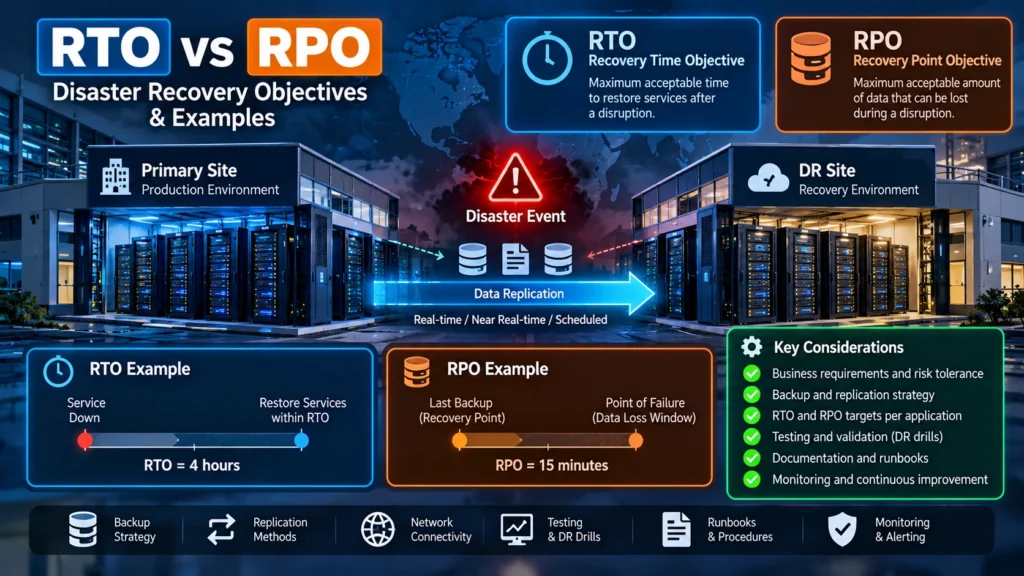
RTO vs RPO Explained: Disaster Recovery Objectives, Examples and Planning
A disaster recovery plan is not complete simply because an organization has backups.
The more important questions are:
How quickly must a service return after an outage?
and:
How much recent data can the organization afford to lose?
These two questions define two of the most important metrics in disaster recovery:
RTO — Recovery Time Objective
and
RPO — Recovery Point Objective
They may look similar, but they measure completely different things.
A simple timeline shows the difference:
             RPO                         RTO
<--------------------------> <-------------------------->

Last Recoverable Data      Disaster                Service
        |                     |                    Restored
        v                     v                       v
--------+---------------------X-----------------------+------> Time

        Potential Data Loss       Acceptable Downtime
RPO looks backward from the disruption and determines how much data loss is acceptable.
RTO looks forward from the disruption and determines how long service restoration may take.
According to NIST, RPO represents the point in time to which data must be recovered after an outage, while RTO concerns how long system components can remain in recovery before negatively affecting business or mission processes. csrc.nist.gov
Understanding this difference is essential when designing backups, database replication, high availability, failover systems, cloud disaster recovery, and business continuity.
For the broader recovery architecture, see Disaster Recovery Explained and High Availability Explained.
What Is Recovery Time Objective?
Recovery Time Objective (RTO) defines the maximum acceptable period between a service interruption and restoration of that service.
AWS describes RTO as the maximum acceptable delay between interruption and restoration. AWS Documentation
Suppose an e-commerce application fails at:
10:00and the organization has defined:
RTO = 2 hoursThe recovery target is therefore:
10:00   Disaster
  |
  |-------------------- RTO --------------------|
                                                |
                                                v
                                             12:00
                                      Service should be restored
RTO answers:
How long can this service remain unavailable?
It does not directly tell us how much data may be lost.
That is the role of RPO.
What Is Recovery Point Objective?
Recovery Point Objective (RPO) defines how far back in time the organization must be able to recover its data.
NIST defines RPO as the point in time to which data must be recovered after an outage. csrc.nist.gov
Suppose:
RPO = 30 minutesand a disaster occurs at:
10:00The organization should be able to restore data to approximately:
09:30 or laterConceptually:
09:30                     10:00
  |                         |
  v                         v
Recovery Point           Disaster
  |<------ 30 min -------->|
RPO answers:
How much recent data can we afford to lose?
RTO vs RPO
The distinction can be summarized simply:
| Metric | Main Question | Measures |
|---|---|---|
| RTO | How quickly must service return? | Downtime |
| RPO | How far back may recovered data be? | Data loss |
| Lower RTO | Faster restoration required | More demanding recovery |
| Lower RPO | Less data loss allowed | More frequent protection |
Another way to remember it is:
RPO = DATA
RTO = TIME
More precisely:
RPO
How much data history can be lost?

RTO
How long can the service be unavailable?
AWS similarly treats RTO and RPO as separate recovery objectives that should be assigned according to workload and business impact. AWS Documentation
The Disaster Recovery Timeline
Consider this timeline:
08:00       09:00       10:00       11:00       12:00
  |-----------|-----------X-----------|-----------|
                          |
                       Disaster
Assume:
RPO = 1 hour
RTO = 2 hours
The recovery requirement becomes:
Data recovery target:
09:00 or later

Service restoration target:
12:00 or earlier
Graphically:
09:00                   10:00                   12:00
  |                       |                       |
  v                       v                       v
Recovery Point         Disaster               Recovery
  |<---- RPO: 1h ------->|<------ RTO: 2h ----->|
This diagram captures the fundamental difference.
RTO Example
Imagine a customer portal becomes unavailable at 14:00.
The organization has:
RTO = 4 hoursThe target is to restore the service by:
18:00The recovery process could involve:
Detect outage
     |
     v
Declare disaster
     |
     v
Provision replacement infrastructure
     |
     v
Restore application
     |
     v
Restore data
     |
     v
Validate system
     |
     v
Redirect users
All of these activities consume part of the available recovery time.
Therefore an RTO is not merely:
Server boot timeIt must consider the complete recovery workflow.
RPO Example
Suppose a database is backed up every four hours:
00:00 Backup
04:00 Backup
08:00 Backup
12:00 Backup
A failure occurs at:
11:50If the most recent recoverable copy is from 08:00, almost four hours of changes may be lost.
That architecture therefore cannot reliably support:
RPO = 15 minutesusing only those periodic backups.
This is one of the most important disaster-recovery principles:
Your technical data-protection strategy must actually support the business-defined RPO.
RPO and Backup Frequency
Imagine backups occur every:
24 hoursA disaster could happen shortly before the next backup.
That creates a potential data-loss window close to:
24 hoursIf backups occur hourly:
Potential window ≈ 1 hourIf they occur every 15 minutes:
Potential window ≈ 15 minutesBut backup frequency alone does not prove the RPO will be achieved.
Other factors matter:
Backup completion
Backup integrity
Replication delay
Restore capability
Application consistency
Database consistency
Backup availability
The real question is:
To what point can the organization successfully recover usable data?
Backup Frequency Is Not the Same as RPO
This distinction deserves emphasis.
Suppose a system performs backups every 15 minutes.
You might assume:
RPO = 15 minutesBut imagine backups regularly fail and nobody notices.
The nominal schedule says:
15 minutesThe actual recoverable point might be:
8 hours agoTherefore:
Backup Schedule ≠ Proven RPORPO must be validated through monitoring and recovery testing.
RPO and Data Replication
Replication can reduce potential data loss compared with infrequent backups.
A simplified architecture might be:
Primary Database
       |
       | Replication
       v
Standby Database
If replication lag is only a few seconds, the standby may contain data very close to the primary.
However:
Replication ≠ BackupIf an unwanted deletion occurs:
DELETE important_datathat deletion may also replicate.
For this reason, a strong disaster recovery strategy often combines:
Replication
+
Backups
+
Snapshots
+
Recovery testing
For the underlying storage concepts, see Storage Architecture Explained.
Can RPO Be Zero?
A theoretical:
RPO = 0means:
No committed data may be lost.
This is difficult to guarantee.
It may require technologies such as:
Synchronous replication
+
Multiple resilient copies
+
Carefully designed failure domains
Consider:
Application
     |
     v
Database A
     |
Synchronous Replication
     |
     v
Database B
The write may not be considered successful until required replicas acknowledge it.
This can reduce data-loss exposure, but it introduces trade-offs involving:
Latency
Availability
Distance
Network reliability
Complexity
Cost
Therefore organizations should not select an RPO of zero merely because it sounds desirable.
Can RTO Be Zero?
Similarly:
RTO = 0would imply effectively no acceptable interruption.
That generally requires the architecture to avoid conventional restore-and-recover operations altogether.
Instead it may require:
Active redundancy
+
Automatic failover
+
Continuous service
+
Multiple failure domains
For example:
             Traffic
                |
        +-------+-------+
        |               |
        v               v
     Site A           Site B
     Active           Active
Even highly redundant systems can still experience transient failures, dependencies, routing problems, software bugs, or correlated incidents.
Therefore “zero downtime” should be treated as a demanding engineering objective rather than an easy checkbox.
Lower RTO and RPO Usually Increase Complexity
Consider three recovery requirements.
Workload A
RTO = 24 hours
RPO = 24 hours
This may be achievable with comparatively simple backup and restore.
Workload B
RTO = 2 hours
RPO = 1 hour
This may require more automation and frequent protection.
Workload C
RTO = 5 minutes
RPO = near zero
This may require:
Continuous replication
Warm or active infrastructure
Automated failover
Multi-site networking
Continuous monitoring
Regular testing
The architectural principle is:
Lower RTO/RPO
        |
        v
More stringent recovery capability
AWS’s disaster recovery guidance similarly organizes recovery strategies from backup-and-restore approaches through pilot light, warm standby, and multi-site active/active designs, with different recovery characteristics and costs. AWS Documentation
How to Determine the Correct RTO
RTO should come from business impact, not from arbitrary technical preference.
Start with:
What happens if this service is unavailable?
Possible consequences include:
Lost sales
Employee downtime
Production interruption
Contract penalties
Customer impact
Regulatory exposure
Safety impact
Reputation damage
Then examine how those consequences change over time.
Example:
| Downtime | Business Impact |
|---|---|
| 5 minutes | Minimal |
| 30 minutes | Noticeable |
| 2 hours | Serious |
| 8 hours | Critical |
| 24 hours | Unacceptable |
If the impact becomes unacceptable after two hours, the service may need:
RTO ≤ 2 hoursThe exact number should come from the organization’s actual business requirements.
How to Determine the Correct RPO
Ask:
How much recent data can the business afford to recreate or lose?
For a static marketing website, perhaps many hours of data loss would not matter.
For payment transactions, losing even a small number of committed transactions may be unacceptable.
Example:
| System | Possible Business Requirement |
|---|---|
| Static documentation | Longer RPO may be acceptable |
| Internal wiki | Moderate RPO |
| E-commerce orders | Short RPO |
| Banking transactions | Extremely short RPO |
| Analytics copy | Potentially longer RPO |
The actual objective depends on business requirements, not the technology label.
Business Impact Analysis
A Business Impact Analysis (BIA) helps determine which services are most critical.
A simple workflow is:
Identify Business Process
          |
          v
Identify Supporting Systems
          |
          v
Estimate Downtime Impact
          |
          v
Estimate Data-Loss Impact
          |
          v
Define RTO and RPO
AWS specifically recommends defining RTO and RPO for each application based on business impact and risk assessment rather than assigning one universal recovery target to everything. AWS Documentation
This is important because not every workload deserves the same recovery investment.
Do Not Give Every System the Same RTO
A common mistake is:
Every application:
RTO = 1 hour
RPO = 15 minutes
This looks simple but may create unnecessary cost.
Consider:
Payment System
Internal Wiki
Development Sandbox
Public API
Archive Server
These systems do not have equal business importance.
Instead:
Critical System
     |
Short RTO/RPO

Less Critical System
     |
Longer RTO/RPO
Tiering workloads creates a more rational recovery architecture.
Application Recovery Tiers
An organization might define its own tiers.
For example:
| Tier | Example | RTO | RPO |
|---|---|---|---|
| Tier 1 | Critical transaction service | Very short | Very short |
| Tier 2 | Important internal application | Hours | Hours |
| Tier 3 | Standard workload | Longer | Longer |
| Tier 4 | Archive/non-critical | Days | Longer |
These numbers are only examples.
Do not copy generic values blindly.
Your organization should determine acceptable downtime and data loss based on impact.
RTO and RPO for Databases
Databases deserve special attention because application recovery and data recovery are tightly linked.
Suppose:
Application restored in 10 minutesbut:
Database restore takes 6 hoursThe application is not truly recovered.
Therefore:
Application RTOmust account for critical dependencies.
A simplified dependency chain might be:
Application
     |
     +--> Database
     |
     +--> Cache
     |
     +--> Queue
     |
     +--> Object Storage
     |
     +--> Identity Service
The practical RTO may be constrained by the slowest critical dependency.
RPO for Transactional Databases
Consider an order database processing:
100 transactions/minuteIf:
RPO = 1 hourthen in an extreme recovery scenario the organization might need to deal with up to:
6,000 transactionsthat occurred after the recoverable point.
That may be unacceptable.
This illustrates why RPO should be expressed not only as time but also understood in business terms.
Instead of asking:
Is one hour acceptable?
ask:
What does one hour of missing transactions actually mean?
RTO for Distributed Applications
Modern applications can have many dependencies:
Frontend
   |
   v
API
   |
   +--> Authentication
   +--> Database
   +--> Cache
   +--> Queue
   +--> Object Storage
   +--> External API
Recovering the API alone may not restore the business service.
The real recovery objective belongs to the business workload, not just one VM or container.
This is especially important for modern backend environments described in the site’s Backend Infrastructure Explained guide.
Disaster Recovery Strategy 1: Backup and Restore
The simplest architecture may be:
Primary Environment
       |
       v
      Backup
       |
       v
Remote Storage
After a disaster:
Provision Infrastructure
       |
       v
Restore Backup
       |
       v
Configure Services
       |
       v
Validate
       |
       v
Restore Traffic
Advantages can include:
Lower steady-state cost
Relative simplicity
The trade-off is typically a longer recovery process.
AWS identifies backup and restore as one of the major cloud DR strategies. AWS Documentation
Disaster Recovery Strategy 2: Pilot Light
A pilot light keeps some core recovery components available while much of the production environment remains inactive.
Conceptually:
Primary Site

Full Production
      |
      | Replication
      v

DR Site

Data + Core Components
Other resources created during disaster
During recovery:
Start / Provision Compute
        |
        v
Scale Services
        |
        v
Validate
        |
        v
Redirect Traffic
This can reduce recovery time compared with building everything from scratch.
AWS includes pilot light among its primary cloud recovery strategies. AWS Documentation
Disaster Recovery Strategy 3: Warm Standby
A warm standby keeps a reduced but functional copy of the workload running.
Primary
100% Capacity

        +

DR Environment
Reduced Capacity
During disaster recovery:
Scale DR environment
      |
      v
Fail over traffic
Because some infrastructure is already operating, recovery can be faster than backup-and-restore or many pilot-light configurations.
The trade-off is greater ongoing cost.
Disaster Recovery Strategy 4: Multi-Site Active-Active
A multi-site architecture can run services in more than one location simultaneously.
               Users
                 |
          Global Routing
           /           \
          v             v
       Region A      Region B
        Active        Active
A failure may result in:
Region A X
   |
   v
Traffic continues to Region B
This can support very aggressive recovery targets, but it introduces substantial complexity.
Challenges include:
Data consistency
Traffic management
State synchronization
Cross-region networking
Application design
Operational complexity
Cost
AWS categorizes multi-site active/active as the most continuously active of its primary DR patterns. AWS Documentation
RTO and RPO Do Not Automatically Select the Architecture
Suppose the business requires:
RTO = 30 minutes
RPO = 5 minutes
That requirement does not automatically mean:
Use active-activeSeveral architectures might satisfy the objectives.
The correct choice depends on:
Application architecture
Data volume
Cloud/on-premises environment
Replication capabilities
Budget
Automation
Dependencies
Operational expertise
Compliance
RTO/RPO define the target.
Architecture defines how the target will be achieved.
RTO vs High Availability
High Availability (HA) and Disaster Recovery (DR) overlap but address different failure scopes.
High availability usually focuses on maintaining service during component failures.
Example:
Server A X
    |
    v
Server B continues serving traffic
Disaster recovery may address larger failures:
Entire Site X
      |
      v
Recover in another location
A highly available architecture can improve RTO, but:
High Availability ≠ Complete Disaster RecoveryFor a deeper comparison, see High Availability Explained.
RTO vs MTTR
Another frequently confused metric is MTTR.
Depending on organizational terminology, MTTR may refer to mean time to repair, recover, restore, or resolve.
The important distinction is:
RTO = Target
MTTR = Observed operational metric
For example:
RTO = 2 hoursbut historical incidents show:
Average recovery time = 3.5 hoursThat indicates a gap.
AWS also distinguishes RTO from MTTR in its recovery-time guidance. Amazon Web Services, Inc.
RPO vs Backup Retention
These are also different.
Suppose backups are retained for:
90 daysThat describes retention.
But backups occur only every:
24 hoursThat affects the possible recovery-point gap.
Therefore:
Retention = How far back history exists

RPO = How much recent data loss is acceptable
You could have:
90-day retentionand still have:
24-hour RPO capabilityif only daily recovery points exist.
RPO vs RTO Example: E-Commerce Platform
Consider:
Customers
   |
   v
Load Balancer
   |
   v
Application
   |
   v
Database
Business requirements:
RTO = 30 minutes
RPO = 5 minutes
That means:
Downtime requirement
Service should return within 30 minutes.Data requirement
Recovery should lose no more than approximately
5 minutes of acceptable business data.
Possible architecture:
Primary Region
      |
      +---- Application
      |
      +---- Database
              |
              | Replication
              v
          DR Region
              |
           Standby DB
plus automated infrastructure provisioning, tested DNS or traffic failover, secrets, monitoring, and application dependencies.
RTO/RPO Example: Internal Documentation
Now compare a company wiki.
Requirements might be:
RTO = 24 hours
RPO = 12 hours
A simpler approach may be enough:
Daily / Frequent Backup
        |
        v
Remote Backup Storage
There may be little business justification for maintaining a continuously running secondary environment.
This illustrates why disaster recovery should be workload-specific.
RTO/RPO Example: Development Environment
A development environment might tolerate:
RTO = several days
RPO = one day
Again, this is only an example.
If developers can recreate much of the environment using automation, infrastructure itself may not need expensive standby resources.
This is where Infrastructure as Code Explained becomes particularly important.
Instead of manually reconstructing networks and servers:
Documentation
     |
Manual Rebuild
an organization can use:
Infrastructure Code
       |
       v
Automated Deployment
which can significantly improve repeatability during recovery.
Dependencies Can Break RTO
Suppose your application can recover in:
15 minutesbut authentication depends on another service requiring:
4 hoursThen:
Application RTO ≠ 15 minutesfrom the user’s perspective.
Similarly:
Application ✓
Database ✓
DNS X
may still mean:
Service XA realistic DR test must therefore evaluate the full dependency chain:
DNS
 |
Load Balancer
 |
Application
 |
Database
 |
Storage
 |
Identity
 |
External Dependencies
Network Recovery Matters Too
Disaster recovery is not only about servers and databases.
A recovered environment may require:
Routing
DNS
Firewall policies
VPN
Load balancing
Certificates
IP addressing
Cloud networking
A perfectly restored database is not useful if users cannot reach the application.
For the underlying connectivity layer, see Data Center Network Architecture Explained and Cloud Networking Explained.
DNS and RTO
Consider failover between:
Primary Site
and
DR Site
If clients reach the application through DNS:
app.example.comthen DNS behavior becomes part of recovery planning.
Questions include:
How is failover triggered?
How quickly are records updated?
What TTL is configured?
Are clients caching old answers?
Is health-based routing used?
DNS can therefore affect practical recovery time.
For the protocol itself, see DNS Explained.
Backups Must Be Recoverable
One of the worst disaster recovery assumptions is:
We have backups, therefore we can recover.
A better question is:
When did we last successfully restore from those backups?
A backup should be considered part of a recovery strategy only if it can be:
Located
Read
Decrypted
Validated
Restored
Used by the application
Recovery testing is therefore essential.
AWS’s DR guidance specifically emphasizes regularly assessing and testing disaster recovery strategies rather than assuming configured mechanisms will meet recovery targets. AWS Documentation
Disaster Recovery Testing
Tests can progress in stages.
A basic review might validate:
Documentation
Contacts
Credentials
Backup availability
A technical test might restore systems into an isolated environment.
Backup
   |
   v
Test Environment
   |
   v
Application Validation
A more advanced exercise may simulate:
Primary environment unavailableand require teams to execute actual recovery procedures.
The important outcome is measurable:
Actual recovery time
vs
RTO
and:
Actual recovery point
vs
RPO
Measuring Actual RTO
Suppose the target is:
RTO = 60 minutesA test produces:
Failure detected:      10:00
DR declared:           10:10
Infrastructure ready:  10:30
Database recovered:    10:50
Application validated: 11:05
Traffic restored:      11:15
Actual service recovery:
75 minutesTherefore:
Target = 60 minutes
Actual = 75 minutes

Result = RTO not achieved
This is useful information.
The organization now knows where improvement is required.
Measuring Actual RPO
Suppose:
Disaster:
10:00
Latest usable restored data:
09:35Then:
Actual recovery point gap
=
25 minutes
If:
RPO target = 30 minutesthe test meets the RPO.
If:
RPO target = 10 minutesit does not.
Common RTO Mistakes
One frequent mistake is measuring only server recovery.
Example:
VM started in 5 minutesand declaring:
RTO = 5 minutesBut perhaps users still cannot access the service because:
Database restoration
DNS change
Firewall configuration
Application verification
remain unfinished.
RTO should reflect recovery of the usable service, not merely one infrastructure component.
Common RPO Mistakes
Another mistake is treating:
Backup every houras guaranteed:
RPO = 1 hourwithout checking:
Backup failures
Replication lag
Corruption
Consistency
Restore success
A target only becomes credible when the recovery mechanism has been tested.
Do Not Define RTO After the Architecture
Another common approach is:
We already have this backup technology.

Therefore our RTO must be whatever it provides.
The better sequence is:
Business Impact
      |
      v
RTO / RPO Requirements
      |
      v
Technical Architecture
      |
      v
Implementation
      |
      v
Testing
AWS Well-Architected guidance similarly states that recovery objectives should be determined from business impact and then used by technical teams to choose a DR strategy. AWS Documentation
Cost vs Recovery Objectives
Recovery objectives involve trade-offs.
Conceptually:
Long RTO / RPO
       |
Potentially simpler DR
       |
Lower continuous resource requirements
versus:
Short RTO / RPO
       |
Continuous replication
Warm/active resources
Automation
Redundancy
       |
Greater engineering complexity
But cost should never be modeled only as infrastructure expense.
You must also compare it with:
Cost of downtime
Cost of lost transactions
Contract penalties
Operational disruption
Reputation damage
The correct solution minimizes business risk, not simply cloud spending.
A Complete RTO and RPO Architecture Example
Consider a production SaaS application:
                            Users
                              |
                              v
                           DNS
                              |
                              v
                      Load Balancer
                              |
                    +---------+---------+
                    |                   |
                    v                   v
                  App 1               App 2
                    \                   /
                     \                 /
                          Database
                              |
                        Replication
                              |
                              v
                         DR Database

Backups --------------------------------> Remote Storage

Infrastructure Code --------------------> DR Environment

Monitoring -----------------------------> Alerts
Requirements:
RTO = 1 hour
RPO = 15 minutes
The recovery plan might include:
1. Detect primary-site failure
2. Declare disaster
3. Activate DR environment
4. Verify replicated database
5. Start application capacity
6. Validate authentication
7. Validate application
8. Redirect traffic
9. Monitor errors
10. Confirm business operations
The organization then tests whether all ten steps complete within the required hour.
RTO and RPO Planning Checklist
Before finalizing recovery objectives, answer these questions:
- Which business process does the system support?
- What happens after 15 minutes of downtime?
- What happens after one hour?
- What happens after one day?
- How many transactions occur each minute?
- How much data loss is acceptable?
- Which dependencies must recover first?
- Where are backups stored?
- How frequently are recovery points created?
- Is replication synchronous or asynchronous?
- What happens if the entire site fails?
- Are credentials available during disaster recovery?
- Can infrastructure be recreated automatically?
- How is traffic redirected?
- Has DNS failover been tested?
- Has the database actually been restored?
- Are backups protected from the same disaster?
- When was the last DR test?
- What actual RTO was achieved?
- What actual RPO was achieved?
The answers should drive the architecture.
Frequently Asked Questions
What does RTO stand for?
RTO stands for Recovery Time Objective.
It defines the maximum acceptable time between service interruption and restoration.
What does RPO stand for?
RPO stands for Recovery Point Objective.
It defines the point in time to which data must be recovered after an outage.
What is the main difference between RTO and RPO?
RTO focuses on downtime.
RPO focuses on data loss.
A simple way to remember them is:
RTO = How quickly?
RPO = How much data?
What does an RTO of 4 hours mean?
It means the organization has determined that the service should be restored within a maximum acceptable recovery window of approximately four hours following the interruption, according to the defined business requirement.
What does an RPO of 1 hour mean?
It means the organization should be able to recover data to a point no more than approximately one hour before the disruption, according to its recovery requirement.
Is RTO the same as backup time?
No.
RTO describes the service-recovery objective.
Backup duration is only one technical factor that may influence recovery.
Is RPO the same as backup frequency?
No.
Backup frequency affects potential recovery points, but RPO describes the business requirement for acceptable data loss.
Can RTO be shorter than RPO?
Yes.
They measure different dimensions and do not need to have the same value.
For example:
RTO = 15 minutes
RPO = 1 hour
could be a legitimate requirement if service availability matters more than preserving every recent update.
Can RPO be shorter than RTO?
Yes.
For example:
RPO = 5 minutes
RTO = 4 hours
means little data loss is acceptable, but the organization can tolerate a longer restoration period.
Does replication guarantee zero RPO?
No.
The result depends on replication type, lag, consistency, failure scenario, and application architecture.
Does high availability provide zero RTO?
No.
High availability can reduce downtime, but failures can still occur and DR planning remains necessary.
What is the difference between RTO and MTTR?
RTO is a recovery objective or target.
MTTR is generally an operational measurement of actual recovery or repair performance, depending on the organization’s definition.
Should every application have the same RTO and RPO?
Usually not.
Recovery requirements should be based on the business importance and impact of each workload.
Who should define RTO and RPO?
They should be driven primarily by business requirements and risk, with technical teams determining how to achieve them.
How often should RTO and RPO be tested?
There is no single universal interval appropriate for every organization. Testing frequency should reflect business criticality, regulatory requirements, architecture changes, and risk.
The important point is that recovery objectives should be validated repeatedly rather than assumed.
Conclusion
RTO and RPO convert disaster recovery from a vague goal into measurable objectives.
RTO answers:
How long can the service be unavailable?RPO answers:
How much recent data can be lost?The relationship is best visualized as:
               RPO                          RTO

<------------------------------> <----------------------------->

Last Recoverable Point       Disaster                    Recovery
         |                      |                           |
         v                      v                           v
---------+----------------------X---------------------------+---->
                             Time
These objectives then influence decisions involving:
Backups
Replication
Snapshots
Database architecture
High availability
Cloud regions
Networking
Automation
DNS
Load balancing
Infrastructure as Code
Monitoring
But RTO and RPO should not begin as technical guesses.
The correct sequence is:
Business Requirements
        |
        v
Business Impact
        |
        v
Define RTO + RPO
        |
        v
Design Recovery Architecture
        |
        v
Implement
        |
        v
Test
        |
        v
Measure Actual Recovery
        |
        v
Improve
The final principle is especially important:
A recovery objective that has never been tested is only an assumption.
A backup configuration, standby database, secondary region, or replication system matters only if the organization can demonstrate that it actually restores usable service within its required RTO and recovers acceptable data within its required RPO.
Continue through the CorgiNetwork infrastructure cluster with Disaster Recovery Explained, High Availability Explained, Storage Architecture Explained, Infrastructure as Code Explained, and Load Balancing Explained.